MDF vs Plywood for Retail Displays: What to Specify Before You Buy
Compare MDF and plywood through the details that matter: finished surfaces, exposed edges, supports, fixings, moisture exposure and purchasing specifications.
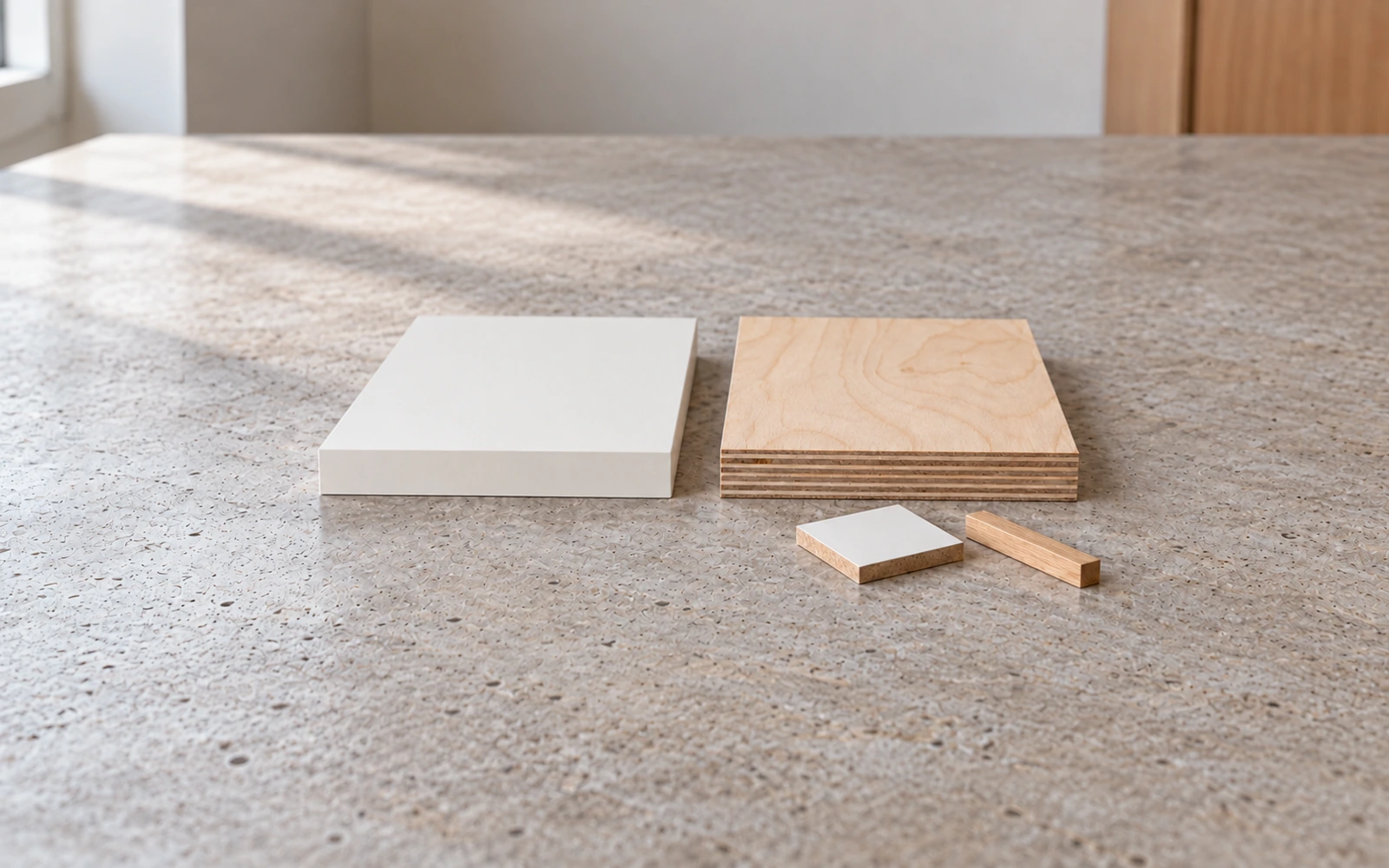
A request for a “wood display” leaves important decisions open. The visible finish, panel core, exposed edges and fixings all affect what the supplier must deliver. Choosing between MDF and plywood is therefore a specification exercise, not simply a choice between two material names.
MDF is worth evaluating for smooth painted or decorative faces. Plywood is worth evaluating when a veneer face or visible layered edge is part of the design. For shelves, joints and repeatedly assembled components, compare the exact panel grade and construction rather than assuming either material family guarantees performance.
This guide helps design and purchasing teams prepare an indoor retail-fixture brief. It does not assign a load rating, recommend a universal thickness or certify a proposed assembly.
1. Separate the visible finish from the panel core
The European Panel Federation describes MDF as a substrate for paint, decorative foils and wood veneers, and identifies different grades for more demanding applications. That makes it a useful candidate for a design requiring a continuous finished face. It does not mean every MDF grade accepts every finish without preparation. European Panel Federation: MDF.
APA describes plywood as cross-laminated veneers bonded together and notes a range of appearance grades. A plywood specification therefore needs more detail than “natural wood”: identify the intended face appearance and obtain a representative sample. APA: Plywood.
Begin with the required customer-facing result. Is it an opaque painted fascia, a veneered cabinet side, a laminated shelf or an intentionally exposed layered edge? The surface treatment and core should appear as separate items on the drawing and purchasing schedule.
2. Approve an edge detail, not only a flat swatch
A small flat colour sample leaves the edges unresolved. Request a sample showing the actual corner, cut edge, coating or edge band proposed for production.
For MDF, ask how machined edges will be prepared and finished. For plywood, ask whether the layered edge is meant to remain visible or receive another treatment. In both cases, review where edges meet metal, clear plastic, graphics and adjacent panels.
Agree what counts as an acceptable visible joint, colour variation and finish. Record the sample reference so that the purchasing team and production team are approving the same detail. A description such as “premium finish” is less useful than a photographed and retained approval sample with written acceptance criteria.
3. Assess shelves and fixings as an assembly
Neither “MDF” nor “plywood” establishes the capacity of a finished shelf. Give the supplier its dimensions, unsupported span, support positions, expected merchandise and how that merchandise will be arranged. Ask the responsible designer or engineer to assess the complete assembly.
The fixing detail also needs a decision. Will screws enter a face or an edge? Will the fixture be dismantled for transport, relocated between stores or assembled repeatedly? Send these conditions with the drawing and request the proposed hardware and assembly procedure.
For a rollout, a prototype should represent the actual supports, panel, finish and fixings. A loose board sample cannot confirm shelf behaviour or repeated assembly performance. Document the agreed verification method and acceptance criteria before ordering the series.
4. Describe exposure and cleaning accurately
Record whether the component will encounter routine wiping, spills, damp storage, nearby entrances or outdoor conditions. Do not use “moisture resistant” as a substitute for this exposure description.
For example, MEDITE states that its MEDITE MR product is not waterproof and should not be used in external environments. This is a limitation of that particular product, not a statement that all MDF products have identical exposure limits. MEDITE MR FAQs.
Likewise, do not treat the word “plywood” as an outdoor approval. Request the exact grade, intended service conditions and finishing instructions for the proposed product. Include exposed edges, drilled holes and joints in the review, alongside the visible face.
Name the cleaning products and routine in the brief. Ask for care instructions for the finished construction, including its coating or laminate, rather than relying on the core material alone.
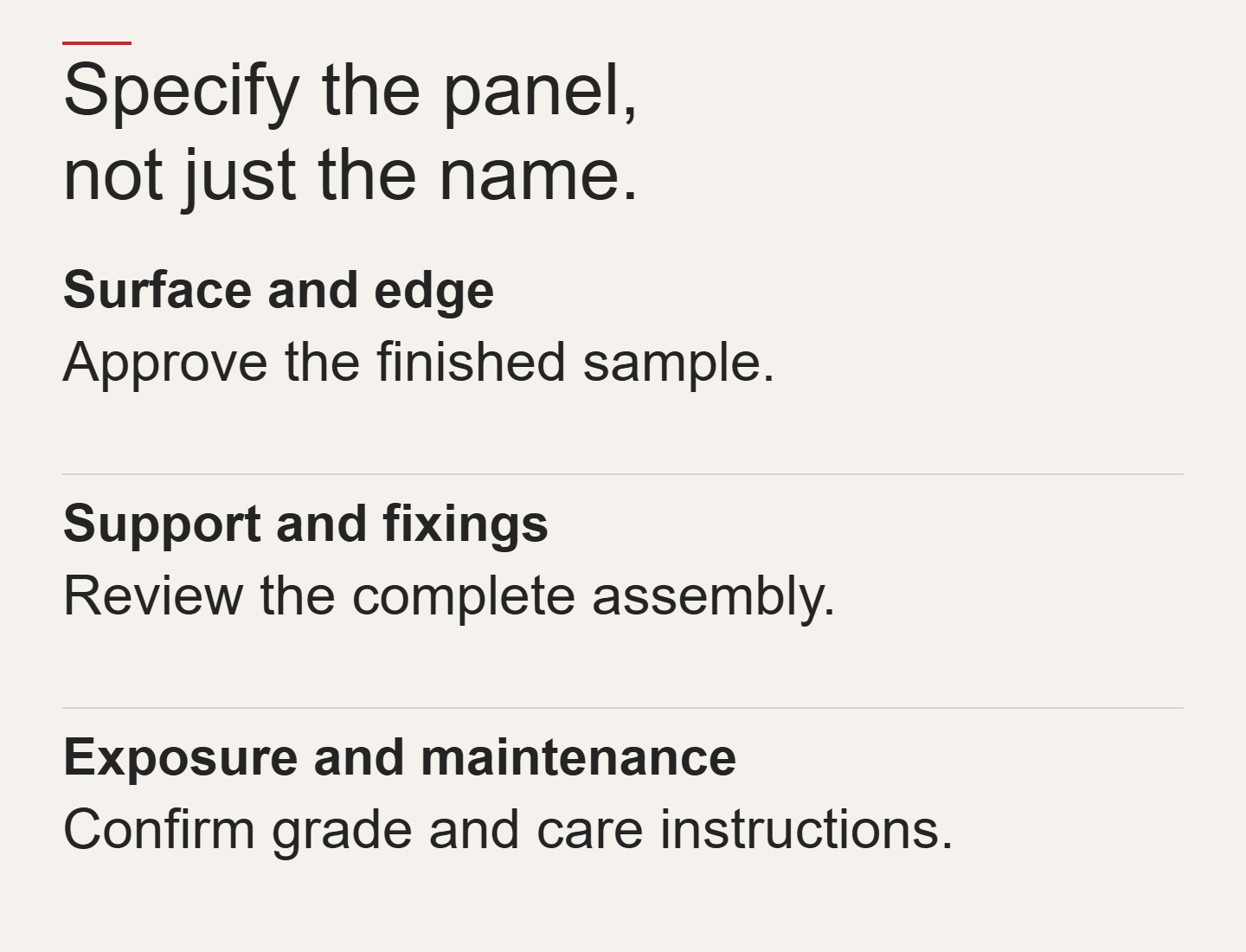
Specify the panel, not just the name.
Surface and edge
Approve the finished sample.
Support and fixings
Review the complete assembly.
Exposure and maintenance
Confirm grade and care instructions.
5. Compare finished proposals on the same basis
The cheapest unfinished sheet may not produce the lowest cost for the approved fixture. Ask bidders to quote the same panel specification, finish, edge treatment, hardware, assembly, packing and replacement requirements.
Use the following comparison to identify missing information rather than declare one material universally better.
| Project requirement | MDF proposal: confirm | Plywood proposal: confirm |
|---|---|---|
| Painted or decorative face | Grade, finish preparation and approved sample | Face grade, finish preparation and approved sample |
| Visible cut edge | Machining and edge-finishing detail | Veneer-layer appearance and edge-finishing detail |
| Shelf or loaded component | Exact panel, span, supports and verification plan | Exact panel, span, supports and verification plan |
| Repeated assembly | Hardware, fixing location and assembly assessment | Hardware, fixing location and assembly assessment |
| Moisture exposure | Product-specific service limits and finished-edge details | Product-specific service limits and finished-edge details |
| Cost comparison | Complete finished part and replacement cost | Complete finished part and replacement cost |
Questions to settle before placing an order
Is MDF always the cheaper option? Compare quotations for the same finished component. Sheet price alone leaves finishing, hardware and handling outside the comparison.
Can the supplier substitute another board? Require the proposed product documentation and a new sample review where the substitution changes the finish, exposure limits or assembly assumptions.
Which documents should procurement keep? Keep the approved drawing, exact panel identification, finish sample reference, hardware schedule, care instructions and agreed acceptance criteria together.
For components with clear panels, use the same specification discipline described in our acrylic and polycarbonate selection guide.
Preparing a retail-fixture brief? Share the intended finish, component drawing, loading and maintenance conditions when you discuss your display project with BEVIS.